Willkommen Bienvenue Welcome

Welcome, gentle readers.

This is an everyday tale of regular folk, who moved from Sheffield to the deepest Corrèze in France Profonde and thence to the rather more cosmopolitan Lot in search of something… different. We certainly found it.

The Lot is an area of outstanding natural beauty. Reputedly, a famous TV globetrotter was asked where, of all the places in the world he had visited, he might return to. He answered, ‘The Lot’.

Fans of Channel 4’s Grand Designs will know that we built a somewhat quirky straw bale house-with-a-view here in the Lot, not far from the celebrated Dordogne river. You can read all about it in my book,
Bloody Murder On The Dog's Meadow, or search for Episode 2 of Grand Designs Abroad on the Channel 4 site. After a break in the proceedings to write a book or two, this blog now takes the form of an everyday journal. Sometimes things happen, sometimes they don't (but the art school dance goes on forever). I hope it will give you an entertaining insight into what it's like to live in a foreign country; what it's like in the slow lane as an ex-pat Brit in deepest France.

I shall undertake to update this once a month, unless absent on leave. Comments always welcomed, by the way, but I do tend to forget what buttons to click in order to answer them.


Sunday, April 10, 2022

April: Choice


At last, after more than a quarter of a century of living in France, we now have the chance to vote for our next president. Unfortunately, if the opinion polls are to be believed, it will boil down to the Hobson's choice of.... 'in the blue corner, the man in the suit, your friend and mine, the career opportunist... E-man-uel Micron; and in the even bluer corner, the bleached blonde breeder of kittens, with the far-right leanings, Maaaaarine Le Pen!!'


For the first round, however, we are presented with a choice of around ten candidates, hope-ful and hope-less. A mixed bunch of idealists and extremists. Each of us received an A4 envelope with manifestos. Given the fact that we don't watch French television nor read French newspapers, our only way of assessing their credentials is by reading said manifestos. But then, we all know that politicians lie and break promises as regularly as decent working people change their underwear. So, I shall be guided by Greenpeace's assessment of their environmental stance. Needless to say, that of the big two is flaky, shaky and ultimately untenable. Fed up with tactical voting, I'll be swayed by environmental concerns. It'll be a wasted vote, but someone's got to vote for an issue that's bigger than the old familiar concerns.

The electoral system, built upon an appalling waste of paper (since multiple duplicates of the manifestos will be spread out on the tables of the Salle Polyvalente where we vote), is puzzling – and therefore, it seems, peculiarly French. This is how it works, unless I have got it all wrong: After presenting your electoral card and your carte d'identité for checking, you go into a little booth and put your candidate's piece of paper into an envelope given to you by the card-checker. You shouldn't, as I did this morning, take a diversion to say hello to the volunteers at the other desk, thus creating confusion as to whether or not you've actually voted.

On your way to the booth – unless you've thought about it beforehand and bring your candidate's piece of paper with you, secreting it carefully in a pocket, say, to ensure that no one sees the telltale name that gives your game away – you pick up a piece of paper for each  candidate so that the volunteers don't spot your choice. In the booth, you put only one piece of paper in the envelope. The rest get chucked in a bin. You don't, as I do each time, attempt to seal the envelope, thus leaving incriminating traces of spit that could be forensically traced to you.


Finally, you take your envelope back to the team of two or three volunteers, one of whom is there to open the little letterbox affair with a knob. You pop your envelope inside and he or she announces 'A voté!' (has voted). I performed this role myself in the recent communal elections during the two-hour lunch period (because everyone knows that the British aren't like the French and don't sit down for a two-hour lunch at 12 on the dot, which makes them the ideal recruits for this graveyard slot), but I suspect that I didn't make my announcements with sufficient conviction or gusto, because so far I haven't been asked back. Perhaps if I gargle regularly and practise a bit more, the day might yet come to pass.

At this point, you sign your name in a little rectangular space on the electoral list and you are now free to walk. It's second nature to the indigenous population, but all three of us somehow find it a very self-conscious and nerve-wracking affair. Quite apart from the business of erroneously licking envelopes, there are other issues that make you question whether you carried out your citizen's duty to the letter of the law. Did anyone see my pre-prepared piece of paper when I pulled out my electoral card? Did I, in fact, put the right piece of paper in the envelope? Will my fellow communards think that I'm an idiot and therefore that all foreigners are stupid?

Come the second round in a fortnight's time, I'm expecting to abstain because I can't bring myself to vote for either the candidate in the blue corner or the candidate in the even bluer candidate. I could register a vote blanc by going through the whole rigmarole again and depositing an empty envelope, which at least means that you will have been seen to have done your duty. However, a neighbour told us that these 'white votes' are not registered statistically, whereas abstentions are – and that, it seems to me, makes them a more satisfactory form of protest.

Our daughter wondered whether you could volunteer to help out and then conveniently lose a few envelopes. I suggested that the number of envelopes would have to tie in with the voting record. If they didn't, I imagine that no one will be allowed to leave the premises until the discrepancy was resolved. So how about removing papers from certain envelopes and turning them into blank votes, she proposed? At this point, I had to exercise my full parental authority. Electoral fraud cannot be condoned in any circumstance, even by a member of one's own family.

So that's it, then. We'll have to wait and see and live with the result, which should be announced soon after typing. The conclusion seems foregone. There will be no pleasant surprises. In times of war and rising prices, people worry about survival in the here-and-now. It's only the privileged few who worry more about survival of the planet. So the silent or not-so-silent majority vote for the candidates who promise short-term solutions to current ails. If, ultimately, Micron gets back in for a second term, I'll try to be a more effective free radical in order to piss the man off TO THE MAX! I wish I had thought to deface his poster, with its ridiculously pat slogan Nous Tous, by adding Avec McKinsey. If it's that nice Marine Le Pen, we'll all have to hope that she doesn't renege on her seemingly more reasonable policies and turn into a female version of another well-known dictatorial animal lover (the one with the hairstyle and the silly moustache).

Vote Nobody – Just to be sure.

Friday, March 11, 2022

March: A Grand Day-Out


In times of war and pestilence, perhaps the last thing on the agenda should be a family day-out, particularly with the price of diesel having gone through the roof. Nevertheless, what else can you do with your spare cash when all is said and done: build an underground bunker and/or sink those anti-tank iron spikes they used in the last European war?

In any case, we had to take The Daughter to the airport in Limoges for her first trip back to the UK since the pestilential brouhaha has quietened a little. It always seems wrong to be taking an airplane, but we don't do it very often and, after reading reports of empty planes 'flying high in the friendly sky' (as Marvin Gaye once put it) simply to keep their slots open at the airports either end, it seemed to be neither here nor there in the great scheme of things. So we dropped her off, I disobeyed the notice on the door that only passengers could enter the airport in order to satisfy a pressing need to use the facilities, and we – the Dame, the dog and I – took off on our projected detour.


For years, we've been driving up and down the A20, our scenic toll-free motorway (Free at least! between Brive and Vierzon, an unedifying dump south of Orléans), and ever since they put up big painted signs to attract passing tourists, we've been aware of Mont Gargan. Somewhere in the hinterlands, just south-east of Limoges. 'One of these days,' one of us would say, 'we must get off the motorway and go and visit Mont Gargan.'

The final day of last month happened to be one of those days: a beautiful balmy late-winter's day under a limpid, cloudless sky with a distinct promise of the spring to come. Besides, a French friend of ours, a photographer by profession who is currently photographing the Limousin for a book, went there early one morning not long ago and reported that it is a wonderful place. On such a day, too, our girl might look down on us from up in the sky and see her parents waving from the summit. On the other hand, the Ryan Air pilot, driven by tight schedules, might prefer to head due north for Stansted.  

We took off cross-country north of Pierre-Bouffière, a little staging post where we once stopped for an early morning coffee when the motorway hadn't even been finished. There's an aire de repos nearby, where I paused a few years later for a rest on a long solo drive south from the Channel back when I attempted such crazy feats of endurance. I remember it well because it wasn't very restful. Alone in the deserted car park, a stray nocturnal car came and pulled up within spitting distance of our old Peugeot 205. It was either a good-ole'-boy looking for a victim or a Mr. Lonelyheart looking for love, I figured. Or perhaps a lady of the night looking for a client. I didn't hang around long enough to find out, but quickly resumed my journey. A spooky episode.

On the cross-country leg of the journey to Mont Gargan, we barely passed a car. The rolling landscape of meadows and woods is dotted with occasional settlements that might harbour a boulangerie, but precious little else. It's a lovely part of the world, but not a part to inhabit unless you have a hermit's chromosomes.

When the road became more hilly, we picked up some signs for Mont Gargan. They lead you up to a village, where you turn hard left and climb a road with woods on either side. Then left again and up to a car park. We followed two vehicles: a private car and one of those pick-ups that good-ole'-boys convert into hunting-dog transporters. It was the final day of February: the day that marks – so we believe – the final day of the hunting season. Just our luck, to stumble in such deserted parts upon a party of hillbillies bent on one last legal slaughter before they have to hang up their rifles. But the pick-up pulled into a lay-by and I watched in my rear-view mirror as it turned round and drove back off again. No doubt, this was a protected public site and they were up to something illegal. Just their luck that two private cars should materialise.

The woman in the other car let her dog out of the back just as we liberated Daphne. She heard us talking together in English and addressed us both nervously in the same language. She was sorry, she explained, but she had just tested positive for Covid. She'd had the requisite vaccinations, though, she added. I reassured her that I'd just had it myself (and didn't give a monkey's whether she was vaccinated or not, but I kept that to myself). We moved off in separate directions.


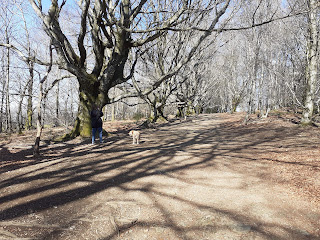
Mont Gargan is around 730 metres high, which makes it a mountain in Britain and little more than a big hill in France. It rises up out of the surrounding countryside in splendid isolation – like the Wrekin in Shropshire, only bigger – so the 360o views on such a beautiful morning were almost limitless. But even more spectacular is the avenue of ancient beech trees that leads you up to the summit: trees like the oak that once hid the fugitive Charles II from the forces of parliament, with branches that spread upwards and outwards. And although I've never seen it, I like to think that this arboreal landmark is as splendid as that tunnel of trees in County Antrim to where the tourists flock now that Game Of Thrones has highlighted the natural wonders of Norn Iron.


The summit is crowned with a ruined chapel that was built in the 19th century for some spiritual purpose that doesn't seem to have lasted long. Perhaps it coincided with the Diaspora of the local population to Paris in search of work. Without a congregation to help with its upkeep, it must have fallen prey to the elements. It sits on a grassy plateau surrounded by bracken. Perhaps in the second world war it was used as a refuge for the local Maquis.

And lo! during our circumambulation of this magical place via the department's thoughtful 'discovery trail' (which, I can confirm, is definitely not suitable for pushchairs; the 40 steps that take you back to the summit were a challenge to two fit people and perhaps even their dog), we learnt that the local Resistance was the sole unit during the war to win a pitched battle with the forces of occupation.

Just a few days later, we learnt more when we went to lunch with an old friend from our days in the Corrèze and his new partner, a retired schoolteacher from Bordeaux. We call Jean-Claude the 'wild man of Wongo'. He's spent most of his adult life leading groups around the countryside to explain which nuts and berries you can live off and which mushrooms to avoid; making films about his patrimony; or restoring old barns in which to house his eco-museums. In the days when we were scratching around for a buck, Jean-Claude gave me some pocket money to help him roof an outbuilding with chestnut shingles. He gave Debs her first break, too, by co-hosting a course in the old school in our local commune, which involved an element of aromatherapy massage. Unfortunately, the publicity they created together involved the use of the word 'massage', which they discovered – when the course was shut down by order of the medical Mafia – was an illegal term for anyone other than an accredited kinésithérapeute (or physiotherapist). For years afterwards, she used the term 'lymphatic drainage'. Now she's old enough and wise enough not to give a flying flacon of essential oil.


Anyway, while we ate our resuscitated mushrooms he'd picked in the autumn, accompanied by a salad of field-fresh dandelion leaves and a hard-boiled egg laid by the chickens, garnished with home-produced walnut oil, and in between consulting his useful notebook of natural nutrition to compare the vitamin content of dandelions, say, to oranges, Jean-Claude told us about the leader of the Resistance in the Haute-Vienne: a chap by the name of Gingouin, who fell out with the French communist party after Hitler and Stalin signed their pact, then organised the local Maquis. After the battle of Mont Gargan, Gingouin disobeyed orders from a communist leader to take Limoges by force, and the rest of his (long) life was characterised by slurs on his character and actual physical abuse from the police and magistrates whose anger he had also incurred during the war. Highly decorated by the state for his war efforts, he was rehabilitated by the commies in 1998 – to which Guingouin replied, rather splendidly: 'It's a problem the Party has with itself. It doesn't concern me anymore. I've reached the age of serenity.'

I haven't quite reached that stage of my life yet. However, Jean-Claude's revelations did inspire me to pitch an idea for an article to my very nice editor at France Magazine. She has commissioned a feature deriving from our grand day-out. So you can read more about Mont Gargan and its history sometime next year at a newsagent near you. If, that is, with the world 'in a state of chassis' (as Sean O'Casey might have had it), such familiar establishments survive until then.

Wednesday, February 16, 2022

February: Incapacity Allowances

I never thought the old man would have so much snot inside him... Nor would I ever have thought that the Omacron variant would linger for more than a fortnight. Since its arrival one night when I just couldn't get warm, it has left me tired, depressed and truculent. I resent being ill, or at least unwell. It's like a slur on my character. Life is far too short to loiter in bed, even though the temptation to curl up like an embryo under the duvet has been very strong.


It was quite another matter as a child, when I would welcome every passing illness as a precious day or two off school: some legitimate quiet time alone under all my many blankets and fusty old eiderdown, and a chance to catch up on some reading or invent a few more cricket series. I was a sickly child, but a good invalid. Apart from a severe dose of measles, I didn't give my mother much to worry about; I just got on with the business of recuperation. I don't remember any medication other than rosehip syrup for tricky coughs and, if I were very good (and/or my grandparents were staying with us), a bottle of every invalid's super-strength superhero, Luke O'zade. The amber fizzy liquid came in an amber-coloured bottle, which was sometimes swaddled in amber-coloured cellophane. It tasted like it was doing you good, because glucose was a major ingredient and it wasn't quite as sweet as Fanta or Coke. I suspect it would have been equally effective and certainly a lot cheaper to have eaten instead a spoonful of sugar or two.

Actually, I wasn't much sicklier than the average child at our school. Given two thousand or so pupils in fairly close proximity, germs must have circulated ceaselessly. I never had the layer of muscle and body-fat that seemed to protect the rugby fraternity. Given the lack of nourishment we were served up in our family, the miracle is that I didn't succumb more often. There can't have been many valuable nutrients in a bowl of rehydrated chicken noodle soup.

With adulthood, I discovered nutrition and started to take responsibility for my well-being. I like to think that I'm probably healthier now than the former rugby fraternity, who've probably gone to seed and fat. A bout of flu is all that I've suffered in the last ten or fifteen years. Hence my indignation at being laid low by the virus. I had begun to think that I was inviolate or that this part of France had special properties to keep the germs far hence. Apparently not. It's in the air and doing the rounds. After many months of hardly knowing anyone among the statistics, I've now heard of all kinds of friends and acquaintances who've had a dose. Our Dutch neighbours up the road went down with it at the same time; two adults and all three children.

It's not nice, I can say that. After that initial sensation of shivering, a headache, a sore throat and a loss of appetite followed. By the second day, I re-discovered my appetite and took that as a cue to get up and get back to life. Probably my biggest mistake. Since then, I've heard the siren-calls of the invalidity bed and succumbed on a few more occasions. There are times when the thought of curling up under a warm duvet is so seductive that you'd find the strength somehow to wade through a pond of treacle to get there.

The most striking aspect of this neo-flu has been the sheer tiredness. I'm usually such a busy beaver that it has been a shock to the system to discover how little I can do. It's all that I can manage to walk the dog. Waves of exhaustion wash over me after the merest exertion; I find myself nodding off at inopportune moments and craving my bed at nine o'clock in the evening. This lack of energy hasn't been helped by a persistent cough. Coughing wears you out and saps your last reserves of energy.

The malady also underlines how repetitive the days can be. Each morning you wake up, hoping for a change in your personal weather, only to discover that you're still coughing and you're still feeling post-apocalyptic: that nasty taste in your mouth and a head that feels like you've been washed up and wrung out during a long night of fever. It's like your own protracted Groundhog Day.

One advantage, however, of feeling so enervated is the legitimacy it confers on postponement and avoidance. Being unwell is a perfect built-in excuse for not doing all those jobs that you could be doing: de-frosting the freezer compartment of the fridge; freshening up the kitchen with a lick of paint; germinating seeds to plant in the vegetable patch; cutting back the sumac before it takes over the garden; rationalising my CDs; cataloguing our films. And so on. They must wait another day. Or week. Or month.


Already into my third week of incapacity, I'm just beginning to sense a light at the end of the tunnel. At least, for all the intimations of mortality and a chastening lesson in what you are and definitely are not capable of under duress, it hasn't been life-threatening. I didn't need a vaccination and I'll have acquired home-made immunity against most future variants. I didn't take any medication and simply relied on plenty of honey, extra vitamins and regular inhalations of essential oils as prescribed by my resident apothecary, The Good Wife of Camp Street. It's certainly not like the plague that carries off the only son of Will Shakespeare and Anne Hathaway in Maggie O'Farrell's compelling novel, Hamnet. Life as a 21st century invalid is a lot more cushy than that of a patient back in the 16th century.

Gradually, the cough grows looser and less spasmodic, the days grow a little longer and the first daffodils underneath the Clerodendron tree appear to be imminent. Up the road, the young man from up river has been pulling out the foundations of his new house with a big yellow Komatsu. There are mounds of red clay on the plot of land. By the look of it, the family won't be plagued by all the rocks in this plot, a mere four or five hundred metres along the crest. The commune is growing, the landscape is changing. When I've got the energy, I must engage him in conversation and find out what materials he's using to construct the house. Concrete blocks, I would imagine. Or wood, perhaps. Straw bales? Hhhrrmphh! A fat load of use in the Great Scheme of Things it was to have been a pioneer. Back in the distant past when I was far too busy to be unwell.


Monday, January 17, 2022

January: Safe Delivery

My seven-week stint of solitary confinement ended on the 29th December. Just in time to celebrate the New Year, only the three of us couldn't be fagged to stay up till midnight. Better to see out the old year by slipping off to bed, the best place in the world, for a half hour's read before sleep transported us all into 2022.


After a couple of days of worrying about whether the refugees would pass their PCR tests in Oxford and thus be able to board the ferry that night at Portsmouth, I relaxed once I heard by text that they'd arrived at Caen and got through customs. After queuing for two hours behind an endless line of British cars, they flashed their French passports and were ushered through without reference to the whole-foods and the Bombay mix from England in the boot of the car.

French roads are a doddle in comparison to those of England. Even so, I never count my chickens and so, being incurably superstitious, I didn't say a word to Daphne about the imminent return of her two missing mistresses. Nevertheless, she was there by the front door, standing expectantly for at least 20 minutes before they turned up an hour before schedule. I was preparing the evening meal and hadn't even heard the car. But Daphne had sensed that something was astir. Their intuition is extraordinary, even more finely tuned than the Good Wife's.

Once the reunion with spouse and child had settled down, we unloaded a car full of dirty clothes, Christmas presents and almost forgotten purchases from my father's flat: the mounted Swoppet cowboys and Union soldiers, for example, bought on eBay during lockdown, and a selection of signed posters in Jack Hurley's wonderful 'Rubbish Seaside' series, a sardonic pastiche of British railway posters of the inter-war years that sheds a murky light on the anti-social and dystopian delights of seaside towns. My personal favourite is Blackpool with its one-word slogan, 'Don't'. I read about him and his work in The Guardian and found that his prints were remarkably affordable, so I ordered a few because they appeal so strongly to my own grim sense of humour. The trouble is... where the hell do I put them? Our walls are already crowded with the art work of family and friends.


The three horsemen of Britains Ltd. remain in their boxes for now, unable to 'swop and swivel' until I work out what to do with them. I take them out from time to time to marvel at the detail that enthralled me as a child. The Union soldiers are now incorporated with my Indian village in a tableau vivant of Wounded Knee on the shelf above my desk, the five of them poised to massacre their enemy. It serves as a memento mori, just in case I should ever forget a key lesson of history, that the history of mankind is beastly.

The protracted absence of my housemates taught me a number of lessons. Although I got along quite well and very productively on my own, there's certainly no substitute for the company of loved-ones – even if we do disagree on which film to watch of an evening, and cooking becomes more of an event, and I don't feel able to play music all day long.

It taught me, too, that we can probably count on friends more than we can our own families. It's quite clear to me now that neither of my sisters would have sheltered a Jewish fugitive during the war. It's possible my brother might have – if you could only get hold of him. My father offered the sofa-bed in his sitting room, but there wouldn't have been much future in the arrangement had the girls failed their tests on their way south and found themselves homeless for however long it might have taken to get back home.

The fear, panic and consternation created by the very idea of a visit from the tested-but-unvaccinated was terrible to discover, and underlined how politicians and the media have combined to propagate a state of mass hysteria and mass hypnosis. Both sisters get their news and views from breakfast television and scurrilous rags like the Mail and seem immune to any kind of rational thinking. If our father died, the younger of the two suggested, I would have his death on my conscience for allowing two fully grown consenting adults to visit a fully grown consenting father-in-law and grandfather – even though she regularly accompanies him to the pub across the road for a spot of lunch. After putting in place some ludicrous protocol for the visit involving opened windows and masks, the older of the two did actually pop round to see them, embraced them both warmly and spent a happy unmasked hour or two before they hit the road for Portsmouth docks.

With all the Grade A+ serious stuff with which to concern ourselves in today's disappearing world, the British public has now got its collective knickers in a thorough twist about Boritz and his drinks parties. Yes, the man is an overgrown buffoon who personifies all that's wrong with the British class system, but in the annals of political corruption such stupidity is about as small as the ludicrous Djokovic Affair that's currently gripped the tennis world. At least Boritz is sufficiently independent of spirit to handle the current wave of the virus with a degree of common sense. And one must ask the question: if Bortiz falls on his sword, who might take over? It's not a pretty thought.

Meanwhile in Vichy France, our micro-president is continuing to piss-off the Resistance, determined to hound those he probably blames for pre-ordering (I'm told) seven doses of 'Medicated Goo' for every adult Frenchman and woman. In his comportment, he reminds me more every day of the classic neatly turned-out, bespectacled Gestapo officer, the one whom you suspect of dreaming up the most vile of tortures. Now that he's got the passe vaccinale through parliament to replace the passe sanitaire that he'd previously said would never be countenanced, I'm preparing to go deeper underground for the long haul.

Thank God for Bombay Mix. My snack of choice will build up my strength for the weeks ahead and all those jobs I've been neglecting while I've been busy editing my mother's memoirs. Jobs, schmobs! 'Teignmouth: The Fun Stops Here', in the words of Jack Hurley's poster. That's a point... I need to find some frames. And then work out where to put them (if, that is, the revenant is willing).